What Happens When Life Changes Faster Than You Do
Michael Carroll was nineteen when his life split in two.
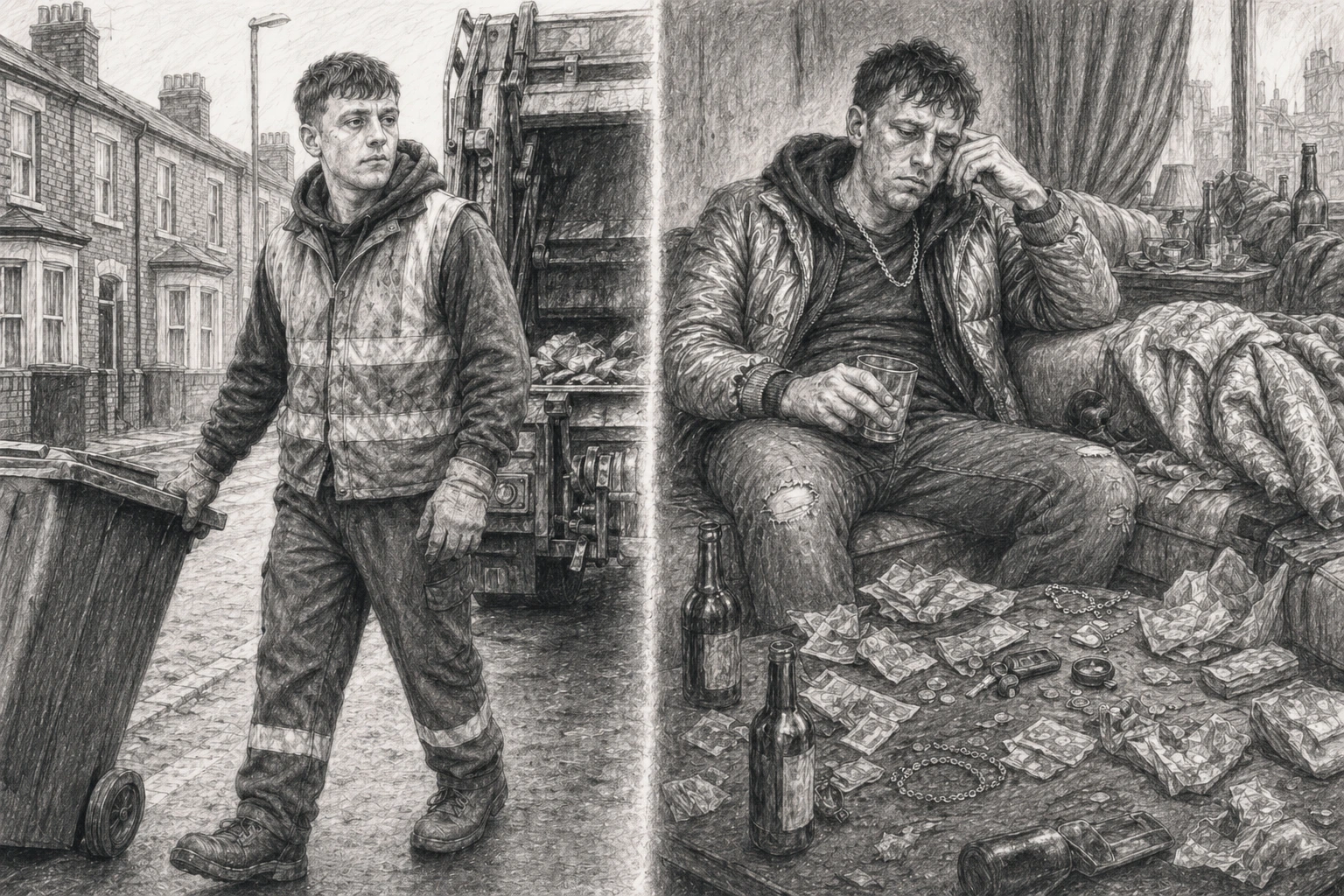
Before the split, he was a refuse collector in England.
Young.
Poor.
Rough around the edges.
Then, in 2002, he won £9.7 million in the National Lottery.
From the outside, it looked like rescue.
A way out.
The end of one life.
The beginning of a better one.
And maybe, for a while, it felt that way.
But money does not only enlarge a life.
It enlarges what is already inside it.
The hunger.
The old wounds.
The self that has not yet learned how to hold more.
Money does not ask whether you are ready.
It arrives.
And whatever was already inside you now has more room to act.
Carroll became a tabloid spectacle.
Houses.
Cars.
Jewelry.
Drugs.
Parties.
What looked like freedom became freefall.
It is easy to say the money ruined him.
But that may be too simple.
The money did not ruin him.
It gave him the means to destroy himself faster.
By 2006, he was almost broke.
By 2010, he had been declared bankrupt and gone back to refuse collection.
At first glance, it looks absurd.
A fortune burned through.
A life circling back toward where it began.
A better life does not automatically feel better if your inner world has only learned how to survive the old one.
If chaos is familiar, peace can feel suspicious.
If scarcity is familiar, having more can feel unsafe.
If struggle is familiar, ease can feel like a trap.
So you shrink the new life back down to the size of the old one.
You overspend.
Pick the fight.
Blow the chance.
Return to chaos.
Not because you want less.
Because familiar is powerful.
Even when it hurts.
That is what people often miss about self-sabotage.
It is not always fear of success.
Sometimes it is homesickness for an emotional world your nervous system already understands.
Most people will never win millions overnight.
But many people know what it feels like for life to offer something they do not yet know how to hold.
A better relationship.
A second chance.
A quieter life.
More freedom than they are used to.
And instead of settling into it, they start looking for the problem.
They create tension.
They pull the new life back toward the old emotional weather.
A bank account can change overnight.
Who you believe yourself to be does not.
And when the outer life expands faster than the inner one, something moves to close the distance.
Not always by rising.
Sometimes by falling.
Not because money is dangerous.
But because an inner ceiling can be powerful.
A new life can arrive before the self capable of holding it does.
So maybe the question is not only:
“What do I want?”
Maybe the deeper question is:
- Can I remain inside something better without needing to destroy it?
- Can I hold peace without turning it into boredom?
- Can I hold love without bracing for loss?
- Can I hold a second chance without shrinking it back down to the size of my old identity?
Michael Carroll was handed a different life.
He just did not yet know how to live inside one.
The question is not whether life will offer you more.
It is whether you will know how to hold it when it does.